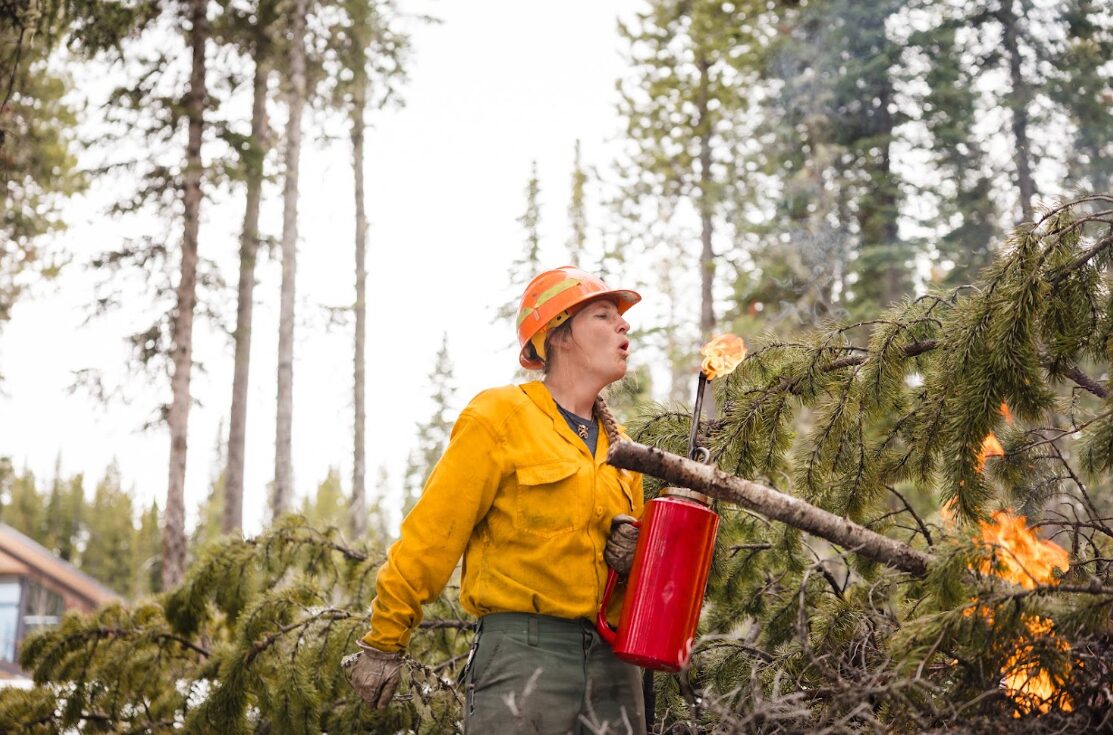
Burn season usually shuts down in early December. That is the general rule, and it is only the beginning of the decision. Snow on the ground doesn’t make winter burning automatically safe, and a new month on the calendar doesn’t make it automatically prohibited. The work depends on snowpack, air quality, atmospheric conditions, where the pile sits, and the condition of the ground beneath it. If the snowpack is light, burning may continue through a narrow early winter window until conditions make it unsafe or irresponsible. That call happens at the site, not on the calendar.
Montana DNRC describes winter burning as very limited because of air quality concerns. Its prescribed fire guidelines generally place it in the category of noncomplex work that cannot be completed at another time and requires snow on the ground. Winter burning is a narrow tool, not a shortcut, and it calls for restraint.
A light snowpack helps. It dampens nearby fine fuels, reduces the chance of surface spread, and gives a crew more control around the edges of the work area. But it is one favorable factor, not permission. Crews still assess the pile, surrounding fuels, slope, access, wind, the air quality forecast, and how the ground is behaving. Relative humidity and temperature still drive the Probability of Ignition, or PIG, the same way they do in fall, and the goal is still control from ignition through mop up, not just getting the pile to burn.
Winter changes the equation because the atmosphere often gets more restrictive even as the ground gets wetter. Montana valleys frequently see temperature inversions, where warmer air sits above colder air near the ground and limits vertical mixing. Instead of lifting and dispersing, smoke settles into valleys and neighborhoods and lingers overnight, affecting neighbors, children, older adults, and people with respiratory conditions. A pile that is well controlled from a fire behavior standpoint can still be a poor choice if the smoke has nowhere to go.
That’s why a permit doesn’t settle the question. The Montana Department of Environmental Quality open burning program grants winter opportunities case by case, reviewing forecasted ventilation and air quality daily. Approval can be withheld, limited to a specific time window, or withdrawn when conditions change. A crew may have authorization for hazard fuel reduction, or HRA, work, but that doesn’t override a poor air quality day. For winter burning in Montana, landowners should expect a permit from the local fire control authority, an approved burn plan, HRA authorization when required, DEQ seasonal review, a same-day approval based on air quality and ventilation, and local restrictions that may be stricter than statewide guidance. Local fire authority and DEQ are separate layers, and either one can stop the burn. The National Weather Service Montana fire weather support page tracks the weather elements every burn evaluation depends on, including temperature, humidity, wind, and atmospheric stability, though its Red Flag guidance is built for wildfire spread, not prescribed burn approval.
Snow depth matters as much as snow presence. Light snow adds moisture, protects nearby vegetation, and acts as a natural control feature while the pile burns. Once snow reaches roughly 16 to 18 inches or more, burning can become dangerous. Fire can burrow beneath the snow and travel through roots, duff, and buried organic material with no visible flame front. The surface looks white and quiet while heat moves below, and smoke may surface far from the original pile. That makes detection slower, access harder, and control more complicated. Deep snow can look like a strong barrier and instead become a blanket over a hidden pathway, so crews have to evaluate what’s happening below the snow, not just above it.
No two winter sites read the same, and conditions can change within a few steps. Shade holds deeper, colder snow. South facing slopes warm and shift quickly while north facing ground stays buried. Crews inspect snow depth and density, exposed fuel, duff moisture, roots, pile placement, drainage, and nearby structures, and watch whether terrain lets smoke lift or traps it. The pile matters too. Compact and loose piles burn differently, wet material smolders and smokes longer, and large logs can hold heat well after the flames are gone. Limited access makes monitoring and mop up harder.
So winter burning can’t be reduced to “there is snow, so it is safe.” A qualified crew reviews the burn plan, confirms restrictions, coordinates with agencies, and reassesses on the day of ignition. If DEQ says conditions are too poor, the burn doesn’t happen, and that isn’t a failure of the project. It’s responsible fire management. Smoke moves through our communities and heat moves through soil and roots, so a decision made on one winter day can affect a property, a watershed, and a neighborhood long after the flames are out.
Firebreak Management helps homeowners, HOAs, and landowners evaluate winter fuel reduction projects with the conditions, permits, and long term forest health in view. To discuss a project in Big Sky or across Montana, contact Firebreak Management.
Further Resources for interested readers: DNRC prescribed fire guidelines, Department of Environmental Quality open burning program, Montana DEQ winter burning information